



The global race to reduce carbon emissions is at a critical moment as land becomes scarce, leading to conflicts over its use. Floating Photovoltaic (FPV) systems, which utilise lakes and coastal waters for solar energy, offer a potential solution to these land-use issues. However, a review presented at the ICOEE conference highlights that the main challenge for floating solar panels is not engineering but rather social acceptance within communities. Achieving clean energy is essential, but it should also support the Sustainable Development Goals (SDGs) equitably for all.
The environmental and technical benefits of FPV are convincing. By installing solar panels on water, we save valuable land that could be used for farming or environmental protection. Water also makes the panels more efficient, meaning they perform better than those on land (Goswami, 2025). They reduce water evaporation, which is especially important in water-limited areas, and can even limit harmful algal blooms (Pouran et al., 2022). This is why global FPV capacity has increased so much, and why the World Bank estimates a potential of around 400 GWp.
Tulp and Dieperink (2026) highlight that technology fails without community acceptance, emphasising the importance of participatory engagement strategies in Dutch FPV projects. Community workshops and transparent communication can foster support, as seen in one project that thrived with involvement, while another faced opposition due to concerns. Procedural justice plays a key role. When communities feel heard, they are more likely to engage positively. Roddis et al. (2020) also noted that past experiences with sustainable energy transitions significantly influence acceptance of wind turbines, stressing the need for early and meaningful engagement.
The link to the United Nations Sustainable Development Goals (SDGs) is crucial, as FPV can help achieve multiple goals simultaneously. It reduces fossil fuel use, supporting SDG 7 (Affordable and Clean Energy) and SDG 13 (Climate Action). FPV also conserves water for SDG 6 (Clean Water and Sanitation) and requires minimal land, aiding SDG 15 (Life on Land) (Goswami, 2025). In Indonesia's remote 3T regions, renewable energy from FPV has lowered CO₂ emissions, created jobs, and boosted electrification (Prasetyo, 2026), contributing to the elimination of poverty (SDG 1) and promoting decent jobs (SDG 8). Furthermore, FPV supports sustainable urban communities (SDG 11) by integrating systems into urban water bodies (Bayindir & Senyapar, 2024).
To fully realise this potential, we must address a significant governance gap in water rights and environmental assessments, which is key to social acceptance. Essential questions include ownership of water surfaces and responsibility for long-term ecological monitoring. A transparent legal framework that fairly manages water use and ecological concerns can build trust within local communities. As Bayindir and Senyapar (2024) emphasise, effective FPV governance is crucial for managing competing claims and ensuring sustainable use of water resources, aligning with SDG 16 (Peace, Justice, and Strong Institutions).
The path forward requires a mindset shift from a techno-economic model of energy deployment to a socio-ecological one. Policymakers must consider social and environmental factors in site selection. Meaningful community engagement should occur from the start, not as an afterthought. We also need transparent benefit-sharing mechanisms, like community funds or discounted local energy rates, to ensure that nearby residents see tangible returns.
We must invest in our institutions to bridge governance gaps, as the quality of governance and public trust are crucial for renewable energy deployment (Virah-Sawmy & Sturmberg, 2025). For countries like Indonesia, this involves addressing regulatory fragmentation and enhancing institutional capacity to assess and monitor the ecological impacts of FPV systems. Building transparent policies and training for environmental agencies can foster trust and ensure ecological safeguards, which are vital for preventing ecological harm and securing community support.
In conclusion, floating solar is a vital part of achieving net-zero. However, technological advancements alone are not enough. The success of this clean energy shift will hinge on community engagement and transparent governance. By prioritising justice and participation, we can make FPV a symbol of a fair transition, one that energises our homes, safeguards the planet, and uplifts our communities. The SDGs offer a roadmap for this integrated approach. We must now muster the political will to support it. A floating solar panel that undermines community trust is not a solution, but rather a new problem.
This opinion piece draws on the paper "Community Acceptance of Floating Photovoltaic: A Literature Review on Environmental Governance Policy toward Sustainable Development Goals", which synthesises 27 peer-reviewed articles and provides the most comprehensive assessment to date of social acceptance factors in FPV deployment.
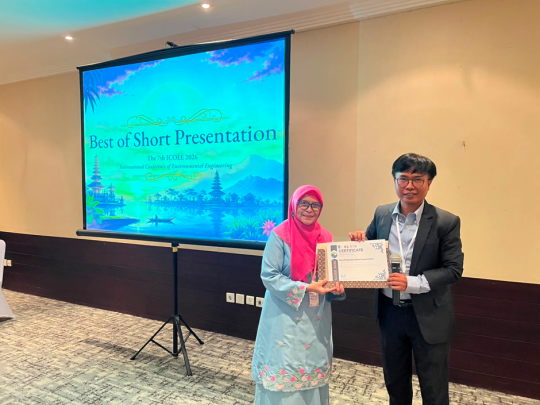
The paper was presented at the 7th International Conference on Environmental Engineering, organised by Institut Teknologi Sepuluh Nopember Surabaya (ITS), Indonesia, held in Bali on 30-31 July 2026. The paper was awarded the best presentation.
This activity is funded by the Indonesian Endowment Fund for Education (LPDP) on behalf of the Indonesian Ministry of Higher Education, Science and Technology and managed under the EQUITY Program (Contract No. 4304/B3/DT.03.08/2025).
Penulis: Delfia Tanjung Sari, Ph. D (Dosen FEB UNAND)